News

The NEW Oak Spring Garden Library site will be online soon!

Oak Spring Garden Library has digitized one of its unique copies of Henri Louis Duhamel du Monceau’s (1700-1782) historical Traite des Arbres fruitiers…, Paris, 1768. Click here to view the pages and discover the finer details of this treasure which was described in An Oak Spring Pomona. This project grew out of Mrs. Mellon’s desire to share with the public select books that have inspired and informed her techniques as a gardener and designer. The library was fortunate to acquire the assistance of Missouri Botanical Garden's digitizing staff.

The site includes:


History


Munting, Abraham 'Naauwkeurige Beschryving...,' plate 13Oak Spring Garden Library comprises Rachel Lambert Mellon's celebrated collection of rare books, manuscripts, works of art and related artifacts concerning gardens, gardening, landscape design, horticulture, and botany. Conserved at Upperville, Virginia, in a striking library designed by Edward Larrabee Barnes in consultation with Rachel Mellon and a new wing designed by Thomas M. Beach in consultation with Rachel Mellon, the collection is both a unique historical archive and a day-to-day working resource. Among Rachel Mellon's own contributions to the art of garden design are the Rose Garden and Jacqueline Kennedy Garden at The White House in Washington, D.C. Her honors include the Officier de l'Ordre des Arts et des Lettres, the Royal Horticultual Society's Veitch Gold Medal, the Henry Shaw Award, and the American Horticultural Society Landscape Design Award, and recently she has been recognized for her assistance during the restoration of the Potager du Roi at Versailles.

The first exhibition of books, drawings, and manuscripts from the Oak Spring Garden Library was titled An Oak Spring Garland (Princeton University Library, October 12-December 17, 1989) in commemoration of An Oak Spring Sylva's publication. More than 56 items were chosen to put on display, including drawings by Maria Sibylla Merian (1647-1717), Vincent Laurensz van der Vinne, the elder (1629-1702), Georg Dionysius Ehret (1708-1770), and Pieter Holsteyn, the younger (c.1612-1673), and numerous others. Manuscripts of Jacob Marrel (1614-1681), Claude Aubriet (c.1665-1742), and Humphry Repton (1752-1818) complimented the selected books by Carolus Linnaeus (1707-1778), Henri Louis Duhamel du Monceau (1700-1782), Johann Christoph Volkamer (1644-1720), and various others. Sandra Raphael's descriptions of the works were included in the exhibition's catalogue.

Mrs. Mellon writes in the preface to the catalogue for An Oak Spring Garland,

"...This collection of books and drawings grew as a way of life, not just a gathering of rare and interesting books bought at the enticement of an enthusiastic bookseller, but chosen one by one for their special and unusual contents and design, as well as their relationship to books already part of the collection. It is a working library where mystery, fascination, and romance contribute to centuries of the art of gardening as a source of discovery." And so the process remains to this day.

Back to the top

An Oak Spring Sylva: A Selection of the Rare Books on Trees

Described by Sandra Raphael (Published by Oak Spring Garden Library, Upperville, Virginia, 1989) Distributed by Yale University Press. ISBN: 0300046529

An Oak Spring Sylva is the first of a series of catalogues describing selections of the rare books, manuscripts, works of art, and related artifacts in the Oak Spring Garden Library, a collection formed by Rachel Lambert Mellon.

This publication, which deals with books and manuscripts on trees, is the smallest volume of the series, describing nearly fifty books, manuscripts, or drawings, from a tiny 1555 book on oaks to early nineteenth-century advice on large-scale tree-planting, a range including both great books, like Evelyn's Sylva, Duhamel's Traite des Arbres, and Michaux's North American Sylva, and more modest ones, like Marshall's American Grove, which helped introduce the riches of American forests European gardens in the eighteenth century. Each description makes clear the background of each book and its relationship to others, while a generous number of illustrations in color and black and white help to give an impression of their contents. Many of the Oak Spring copies have particularly interesting associations, recorded in inscriptions, bookplates, or binding details, all of which are described.

The Preface

My first awareness of the outside world, beyond the caring and loving hands that surrounded me, was of being very small near a bed of tall white phlox in my godmother's garden. This towering forest of scent and white flowers was the beginning of ceaseless interest, passion, and pleasure in gardens and books. Like a magic carpet it has carried me through life's experiences, discoveries, joys, and sorrows. In sadness especially, it has been a hiding-place until my heart mended.

Beginning with infants' rag books of coloured pictures printed on coarse cloth, through all the books of early childhood, I was led on and on. I will never forget the illustrations and drawings of Beatrix Potter's greenhouses, flower-pots, and potting sheds, Kate Greenaway's verses and books, in which fruit trees full of apples and pears hang over pale brick walls, Boutet de Monvel's precise drawings with the music of French nursery rhymes written across pictures of bridges, tall, square, French houses, and trees planted in rows like soldiers. But of all these my favourite illustrator was H. Willebeek Le Mair. Her pictures in Songs of Childhood, Robert Louis Stevenson's A Child's Garden of Verses, and other books were a young gardener's delight - walls, topiary trees, fruit arbours, sand dunes, and fields of wild flowers.

Fairy tales followed, never to end, with illustrations including those of Arthur Rackham and Edmund Dulac - Rackham's knarled oaks and apple trees, willows and windswept hills, and Dulac's medieval turrets where ladies embroidered and planted carnations, roses, and herbs as men battled in the distant landscape.

Not satisfied with these books on the shelves of my room, there was a challenge to re-create and translate them into life. Beginning in our garden sand-box, then later in flat wooden boxes like large seed trays, I built miniature gardens using glue, paint twigs, and whatever helped to simulate these enchanted pictures. Small plants lined my window-sill, and I gathered wild-flower seeds as if they were gold found in streams. My New Hampshire grandfather, to whose memory this books is dedicated, encouraged this enthusiasm, leading me through woods and up mountains, and taking me on trips to Concord, Massachusetts, to learn and study the world of Thoreau, Emerson, and Hawthorne. These memories are a small part of the beginning of the Oak Spring Garden Library. Years of continued curiosity have added botanical and horticultural studies, garden designs, drawings of plants, biographies of naturalists and explorers, accounts of their ships, their journeys, and their discoveries. Everyday books on gardening and related subjects have been collected over the years and now most of the great books as well have been added.

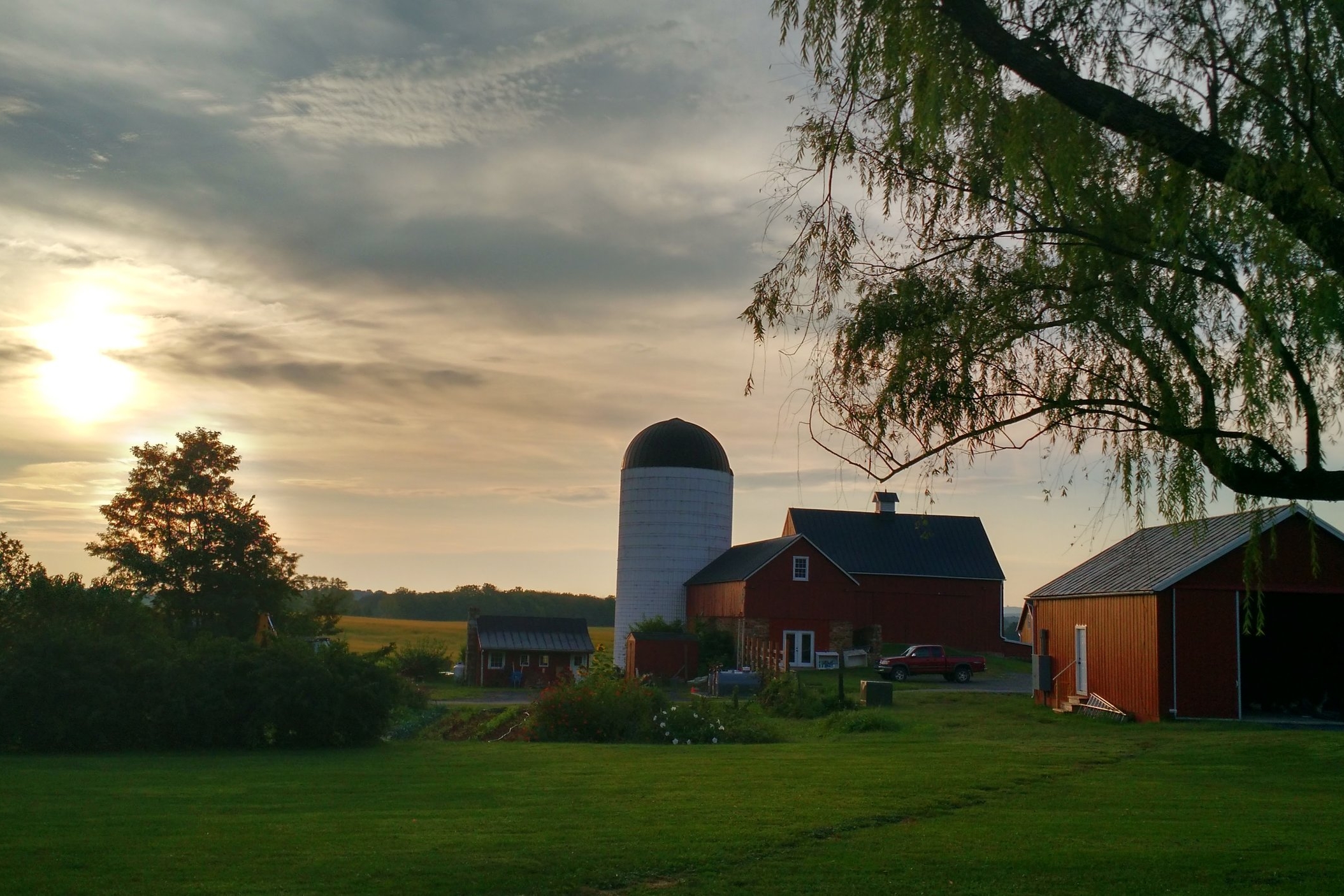
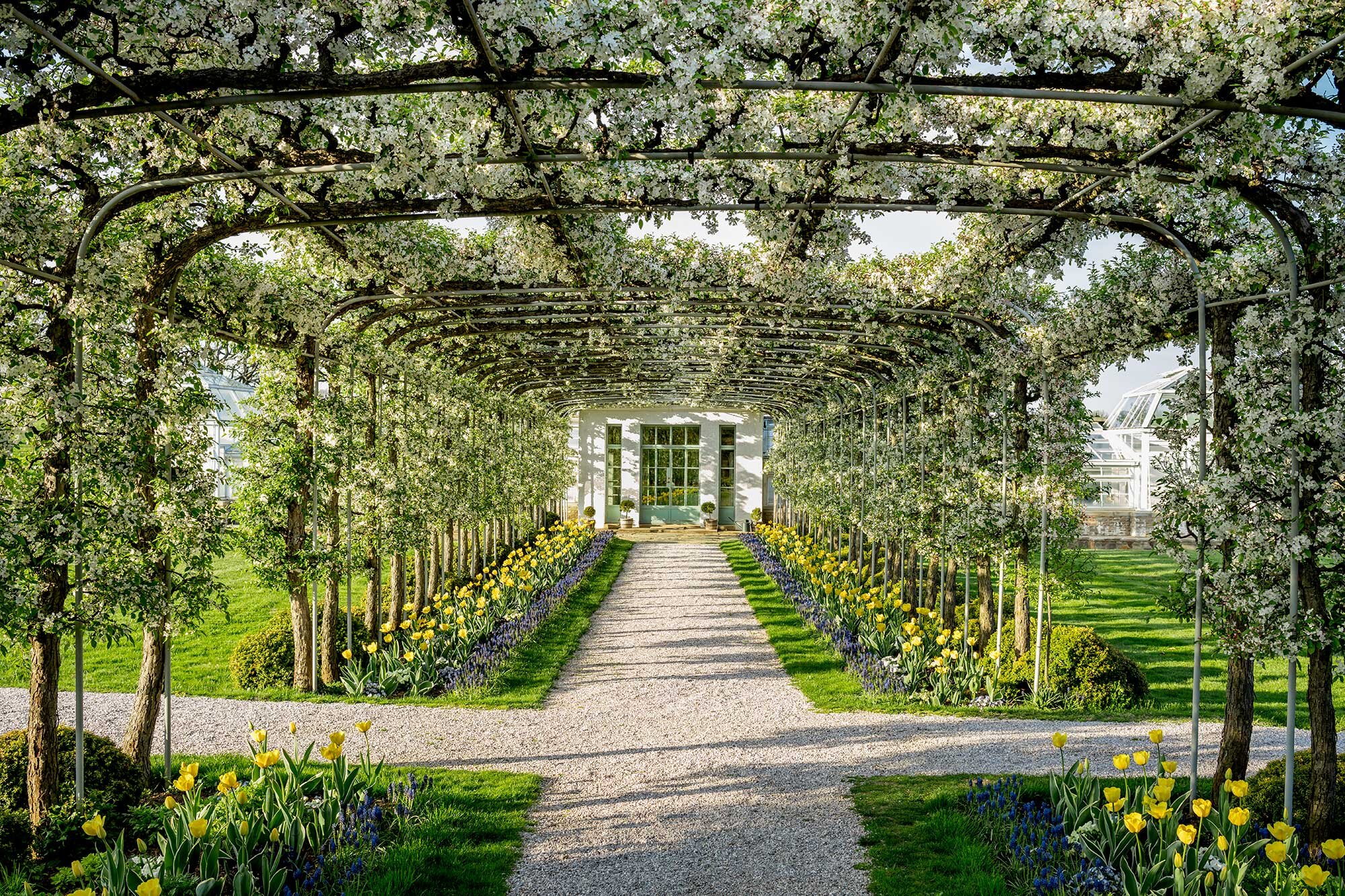
These reflections of a lifetime interest are kept in a whitewashed building made of local stone, a gift from my husband Paul. It stands in an open field, wild flowers grow where they will, apple trees are espaliered to the east and west. Inside, the sun casts long, bright shadows across the room on to the white stone walls. These books about the outdoors live not in dusty darkness but behind simple, pale oak doors, easily opened to the world they tell about. Two large glass doors create an opening twelve feet square in the long wall, framing an ancient hackberry whose lacy branches are caught up in witches' brooms. Beyond this is a rolling landscape of grass and corn fields, outlined in native trees: dogwoods, willows, maples and ashes.

I want to thank my dear friend and librarian, Dita Amory, and her assistant, Tony Willis. Without Dita's organization and constant supervision over the past eleven years it would have been impossible to reach the important goal of beginning to publish a catalogue. Books were scattered in many directions for lack of space, and it is because of her patience and courage, starting long before the library building was completed, that we were able to move in and arrange the shelves of books that form this collection.

I am grateful to Sandra Raphael for accepting the encouragement of Niall Hobhouse and John Baskett to leave her work in Oxford to come to Oak Spring and stay for long periods to research and write this catalogue. Her superb knowledge of garden history has brought to life both people and gardens of the past, linking their common interest in different countries and centuries throughout the world. I appreciate her profound respect of accuracy that will benefit botanical and horticultural scholars in the future. A gardener herself, she has shared with affectionate interest the gardens of Oak Spring, bringing together the resources of the library with everyday life of the farm.

Rachel Lambert Mellon

Oak Spring

January 1989

Back to top

An Oak Spring Pomona: A Selection of the Rare Books on Fruit

Described by Sandra Raphael (Published by Oak Spring Garden Library, Upperville, Virginia, 1990) Distributed by Yale University Press. ISBN: 0300049366

An Oak Spring Pomona is the second of a series of catalogues describing selections of rare books and other materials in the Oak Spring Garden Library, a collection formed by Rachel Lambert Mellon.

The Pomona describes one hundred books and manuscripts about fruit, with illustrations taken from some of the most beautiful books on the subject, as well as from original drawings and paintings. The earliest book described is Bussato's Giardino di Agricoltura of 1592, the latest The Herefordshire Pomona, and encyclopedia of apples and pears from the 1870s. In between there is a gathering of fruit books large and small: La Quintinie's Instruction pour les Jardins Fruitiers, first published in 1690 and translated by John Evelyn three years later, Duhamel's Traite des Arbres Fruitiers, and nearly fifty others from France and Britain, among them Brookshaw's giant Pomona Britannica and a handful of pocket-sized books of directions for grafting and cultivating the best varieties available. Sections on fruit-growing in these two countries are followed by others on fruit elsewhere in Europe (including the books of Knoop, Gallesio, and Bivort) and fruit in America (with Downing, Hovey, and several sets of nurserymen's plates), with chapters on citrus fruit (beginning with Ferrari's Hesperides of 1646), apples and pears, peaches and soft fruit, grapes, melons, and tropical fruit. Each description makes clear the background of the book concerned and its relationship to others, while a generous number of illustrations in color and black and white help to give the impression of their contents. Many of the Oak Spring copies have particularly interesting associations, recorded in inscriptions, bookplates, or binding details, all of which are described.

The Preface

Fruit - the subject of the second volume of the Oak Spring Garden Library catalogues - takes up a larger space on the shelf than some of its companions. Children often find their symbols of stability and peace among the daily presence of things they love. For me they were apple trees. The driveway to our house was lined with apple trees. Leaving early in the morning for school and returning in the afternoon they were always there to welcome me. I knew their shapes by heart. Spring came with blossoms and wild violets that crept into the grass around them, followed by summer's heavy shade and autumn's red and yellow apples. Winter had a magic way of creating blue shadows on the snow that moved with the sun.

When the time came to plant my own fruit trees I made a search for books of instruction on this special subject, but there were not contemporary books to be had in the twenties and thirties. Turning to bookstores handling old and rare books I found my prize, which is still my favourite: the 1821 Jardin fruitier by Louis Claude Noisette (1772-1849). The inspiring illustrations and sheer beauty of the book in the beginning were balanced by the difficulty of translation, so the search continued and now, many years later, we have this catalogue - one might say the fruit of curiosity and love that started with an apple tree.

One cannot leave the subject of fruit without bringing to this preface the name Jean de La Quintinie (1626-1688), the extraordinary seventeenth-century gardener who introduced methods of fruit culture and pruning that are still followed today throughout Europe. His study and practice of this subject caused him to be sought after as a gardener by many owners of large estates, including Charles II, King of England. Although he visited that country several times he chose to remain in France, loyal to Louis XIV for whom he designed the Potager du Roi at Versailles. This garden planned three hundred years ago still exists today, a living witness to the wisdom and theories of La Quintinie, where acres of espalier fruit trees are protected by the Government of France.

I am profoundly grateful to the staff of the Oak Spring Garden Library - Tony Willis, Eugene Howard, Dorothy Tines, Fred Wines, and Mary Ann Thompson - who, with the guidance and encouragement of my dear friend and librarian, Dita Amory, have continued for the past eleven years to preserve the special spirit and atmosphere of this country library. Without the sensitive and talented design of Mark Argetsinger and the perfection of the photography of Greg Heins this book would not have captured the true images of individual books. As a historian and writer Sandra Raphael has told with humour and intelligence the story of each volume, creating a book of garden history on the pattern of a book of short stories.

Rachel Lambert Mellon

Oak Spring

May, 1990

Back to Top

An Oak Spring Flora: Flower Illustration from the Fifteenth Century to the Present Time.

Described by Lucia Tongiorgi Tomasi. Translated from the Italian by Lisa Chien with bibliographical descriptions by Julia Dupuis Blakely (Published by Oak Spring Garden Library, Upperville, Virginia, 1997. Reprinted with corrections, 1998). Distributed by Yale University Press. ISBN: 0300071396

This authoritative and magnificently illustrated presentation of the art of flower depiction in the West is the third volume in a series of catalogues that describe the rare-in some cases unique-books, manuscripts, and other works of art conserved at Oak Spring Garden Library, a collection formed over many years by Rachel Lambert Mellon.

The author, Lucia Tongiorgi Tomasi, has selected more than one hundred items from Oak Spring's extensive holdings, which include superb manuscript florilegia, botanical prints, books of instruction of every kind, still-life and vanitas paintings, and various ornamental ceramics and textiles. Among them are examples by some of the greatest names ever to have worked in either scientific or decorative botanical art-Jacques Le Moyne de Morgues, Georg Dionysius Ehret, Nicolas Robert, and Pierre Joseph Redoute.

An Oak Spring Flora is thematically organized, with topics ranging from Tulipomania and women artists to Dutch and Flemish painting and the search for exotics in remoted lands. In her introductions, the author provides the personal and contextual backgrounds that are essential for a real understanding and appreciation of floral illustration past and present. The sheer beauty as well as extraordinary skills encountered in, for example, manuscript florilegia by Jacob Marrel and Hans Simon Holtzbecker, hand-colored books by Pierre Vallet and G.B. Ferrari, and flower studies by John Constable and others, are testament to the high status accorded floral illustration over the centuries.

The Foreword

Flora ,the third volume in the Oak Spring Garden Library series of catalogues, begins with my first flower book, a small volume given to me by my grandfather when I was just eleven. It was part of a series written for children as a guide to natural history. Bound in brown cloth, it traveled everywhere with me, a bible in its importance.

Our family house in Princeton was surrounded by open fields that led me into the pleasure of discovery. As a child, wildflowers were part of my feeling of freedom - hidden under larger plants or creating fields of lavender thistles that coloured the landscape like a sea in the wind. The intense bright yellow of buttercups made me think that if ever I had to live alone in a cellar room, I would paint it yellow and never miss the sun.

My curiosity went beyond the family's garden flowers. Flowers planted in broad strokes of single colours were remembered from seeing acres of yellow mustard and blue flax throughout Europe. Flowers are the paint-box of garden design, and they can create a sense of peace and simplicity.

Countless imaginative creations have found their expression in flowers, and the cycle of their life has the strength of sensual pleasure with their scent, fruits and seeds. Their presence inspires our tired spirits with their fragile being, and allow our minds to go beyond its earthly limits. Poets and lovers wander into their secret realms, hoping for permission to share a part of their mystery. My collection of books gathered over the years since my childhood was picked one by one for its unique quality and interest, not as part of a long list of well-known flower books. Time and space did not allow for clutter or random acquisition.

Years of collecting brought with it new ideas and new friends that have built a life for me beyond the Garden Library's walls, and opened unexpected doors. A lovely example in my friendship with Lucia Tongiorgi Tomasi, an Italian professor who came to the Library from the University of Pisa. As the author of this volume of flora, with her extraordinary knowledge of flowers and botanical illustration she has helped me not only to describe these books, but as a gentle and understanding friend she has shared many discoveries and insights which bring them alive. I hope this catalogue will bring every reader and gardener the same interest and enthusiasm that Lucia has brought to me.

It is a great pleasure to work again with Mark Argetsinger. His exceptional taste and experience in designing books is combined with the enthusiasm we share working together. Greg Heins, a talented photographer and friend, has again photographed the works of art, books and manuscripts with flawless reality. I thank him for his patience and caring over many years. I am sincerely grateful to Julia Blakely, a rare-book librarian who has brought years of experience with her and is now a permanent part of the Garden Library. Her bibliographical descriptions cover each book included in Flora. At the suggestion of William Robertson of The Andrew Mellon Foundation, the Library was fortunate in securing the advice and help of Susanna Tadlock as production manager. She had previously been in charge of The North Point Press in California, and has brought confidence and direction to all our efforts. I am especially pleased and thankful as I find organization the most difficult part of creativity. We appreciate very much Robert Williams, who as copyeditor corrects each manuscript as it arrives on his desk in London. And last, for my two dear collaborators from the beginning - when our books were housed not in a building but in cardboard boxes piled in cellars - Dita Amory and Tony Willis. They have been present in rain or shine with the encouragement and strength to carry the Library from a dream to reality. My arms go around them both.

Rachel Lambert Mellon

Oak Spring

January, 1997

Back to Top

Faqs

  • Is the library open to the public?

    Currently, the library is not open to the public. Queries concerning the collection are accepted via regular mail.

  • How do I contact the library?

    Please send correspondance to:
    Oak Spring Garden Library
    1746 Loughborough Lane
    Upperville, Virginia 20184
    U.S.A.

  • How can I purchase books from the Oak Spring series?

    Our books can be ordered online and through any regular bookstore. You may use the ISBN numbers given in the descriptions above for accuracy. Please support independent/privately-owned bookstores!

  • Who is the distributor for your publications?

    In the U.S.:
    Yale University Press
    P.O. Box 209040
    New Haven, Connecticut 06520-9040
    phone: (800) 987-7323

    In the U.K.:
    Yale University Press
    23 Pond Street
    London NW3 2PN
    phone: 171-431-4422

  • When will An Oak Spring Hortus be published?

    An Oak Spring Hortus I and An Oak Spring Hortus II are going to be combined into one volume, which will simply be titled An Oak Spring Hortus. We are still working on this publication and would be glad to put your name and address on our mailing list. Send a postcard or letter to the address below, or fill out the form below.

  • How can I be informed with updates concerning the library and its publications?

    You can fill out the form below.

    First Name: Last Name:
    Address #1:
    Address #2:
    City: State:
    Zip Code:
    Country:
    Email:


Web page by Bret Payne

Copyright © 2002 Oak Spring Garden Foundation

The images [and/or other materials] on this web site are the property of, and copyrighted by, the Oak Spring Garden Foundation. You may view, print, photocopy, and download images [and/or other materials] from this site without prior permission only if you are using the images [and/or other materials] for research, instruction, and private study, and provided that you give the following credit:

(c) 2001 Oak Spring Garden Foundation.

Prior permission is necessary for any other use of the images [and/or other materials] on this site, including but not limited to displays (other than for research and instruction), publications, and commercial uses of the images [and/or materials]. Please contact Bret Payne by e-mail for such purposes.